.jpg "Headley Road, Grayshott")
Click to list all articles in this topic
 |
Articles???Total News: 40???Total Reads: 327377 |
|
Articles:
|
Most recent article: Stained Glass Windows of St. Luke's Church Stained Glass Windows of St Luke?s ChurchRecords suggest that stained glass windows were first introduced in the first century. However, from the beginning of the 11th century, many churches were built in England and it was during this period that stained glass windows were introduced, using coloured glass held in place with strips of lead. These windows typically showed representations of biblical characters and teachings and were used for both decorative and informative purposes. Often windows were donated by members of the congregation or by families as memorials of loved ones. Unfortunately, many of these early windows were destroyed during the period of the Dissolution of the Monasteries and by Oliver Cromwell?s puritans in the 16th and 17th centuries. Stained glass windows were produced by both individuals as the designer and manufacturer and by firms employing artists/designers and craftsmen. Commercial manufacture had commenced in the 1830?s, and there were some twenty-five firms that exhibited their work at the Great Exhibition of 1851. However, around this time, William Morris advocated the return to cottage crafts and the use of old skills and together with a number of his peers, formed what is now known as the Arts and Crafts Movement. This in turn led to a major revival of the use of stained glass in churches throughout the country, with members of the public contributing to the commissioning of windows for the local parish church. Churches are generally large buildings, consequently architects designed the building to include large windows to let in as much light as possible. Typically, windows tended to be either two or three light lancet windows. In addition, trefoil and quatrefoil windows were included within the design, such as those that can be seen in St Luke?s. When St Luke?s was first built, all of the windows which, with the exception of the East Window, are either two or three light windows, were of plain glass except for an inner border of red glass in line with the tracery of each window. This can be seen today in the upper windows of the nave, the large West window and the glazed windows in the tower. It was not until August 1910 that the first stained glass window, in memory of Isabelle Tomkins (nee dePury ), was installed in the south wall of the chancel. Today, there are a total of eleven such windows all of which, with the exception of the window commemorating the Centenary of St Luke?s, are memorial windows. The windows are a mixture of standard designs and designs by renowned artists. The Artists/DesignersJ. Wilson ForsterJoseph Wilson Forster was a Victorian artist born in the district of Chorlton in 1861. Son of Joseph Binyon Forster and his wife Mary (nee Beakbane), he studied at the Royal Academy School c.1892. In 1894 he married Ethel Rawlinson, daughter of George Rawlinson, Canon of Canterbury. For many years, Joseph Wilson Forster lived at 36 Falconer Road, Bushey, Herts and used brick built studios at the rear of the premises. Described as a Painter and Illustrator and worker in stained glass, he ran a school of Arts and Crafts in Bushey c.1910-1915 and later at 36 Falconer Road. He died in 1938. The East window and one other in St Luke?s were designed by J. Wilson Forster. (see below) Jessie BayesJessie Bayes was born in London in 1878, the youngest daughter of the artist Alfred Bayes and his wife Emily (nee Fielden) and sister to the painter Walter Bayes and sculptor Gilbert Bayes. They lived in Fellows Road, West Hampstead.
?
|


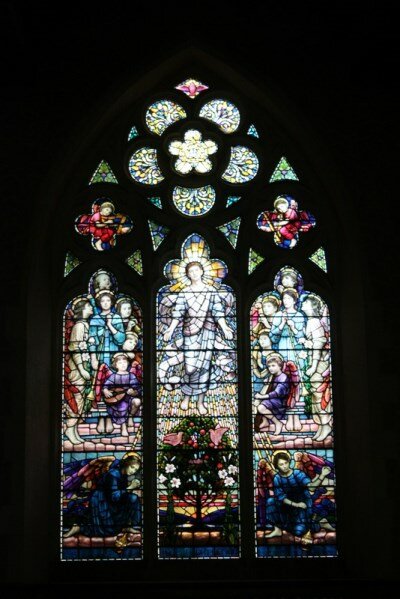 |
Depicting: Christ in Glory Designer: Joseph Wilson Forster Memorial to: Edward Blakeway I?Anson & Catherine Blakeway I?Anson Date: 1918 |
A signed board by J. Wilson Forster describes his design as follows:
In the figure of Christ I have endeavoured to express Immortality and Love inspired & illuminated by the Divine Light emanating from God-whose Almighty Presence is symbolised (in the central light of the tracery) by the Greek letters Alpha & Omega, surrounded by the Circle as expressing Infinitude-the Triangle as signifying the Trinity in Unity and by flames of unquenchable Love.
Beneath the Feet of the Christ blooms the Tree of Life- its roses are symbolical of love- as are also the parent birds with their nest of young ones.
Below is the dawn of the rising sun (which might be expressed in the words:-Arise, shine, for thy light has come, & the glory of the Lord is risen upon thee)
Its rays are reflected in the river of life.
The lilies are emblems of purity.
The censing Angels represent God?s ministers-the one offering up to Him the prayers of His children, the other casting the fruition of them in blessings over the earth.
The groups of Angels are celestial beings, praising God, and expressing their joy on divers instruments of music- as are also the child Angels playing upon harps.
The Vine & the Fig, both are symbols of the Divine Life:- the Vine of the Blood-which is the Life-and the Fig symbolising that it blossoms interiorly.
Above all hovers the Holy Spirit ?descending from heaven like a Dove?.
Chancel-South Wall
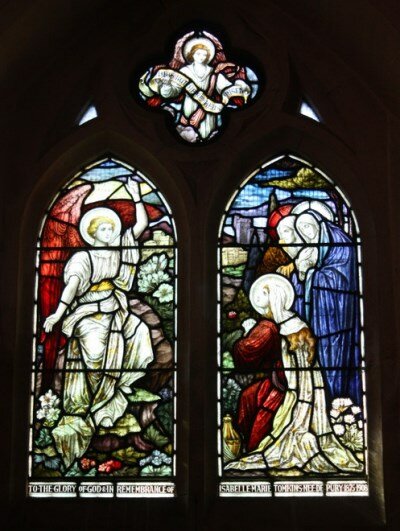 |
Depicting: The Resurrection Designer/Manufacturer: Heaton, Butler & Bayne-(signed) Memorial to: Isabelle M Tomkins-nee dePury Date: 1910 |
?South Aisle-East to West
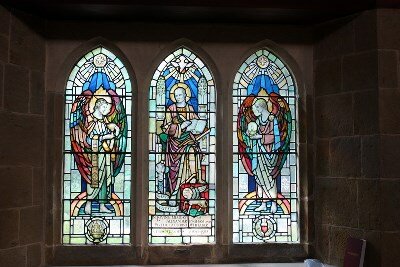 |
Depicting: St Luke writing his Gospels. Designer: Jessie Bayes Manufacturer: William Aikman studios Memorial to: Alexander Ingham Whitaker & Berthe C. Whitaker Date: 1953 |
?
Jessie Bayes describes her design as follows:
The central figure is St Luke writing his Gospels. Below is a winged Ox, his symbol in Sacred art. Ezekial 1-10.
The Angel on the left carries a stole, the symbol of Obedience and a cup of Healing. The four herbs are Coltsfoot, Euphrasia, Calendula and Balsam. The censer of incense is a symbol of Prayer. Revelations 8-3. The Angel on the right holds the lamp of truth in Holy Scripture. The four herbs are Digitalis, Chamomile, Rose Hips and Marjoram.
Below is the Heart of the Blessed Virgin Mary pierced by a sword, as foretold by Simeon when he uttered the Nunc Dimittis as recorded in the Gospel of St Luke 2-35
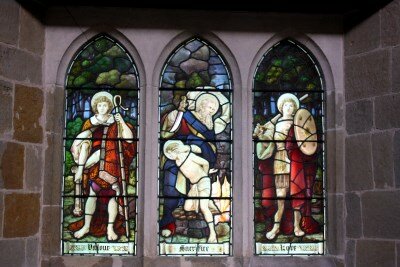 |
Depicting: Sacrifice of Issac Designer/Manufacturer: Percy Bacon Memorial to: 2nd Lt. Arthur Brickwood-1st Battalion York & Lancaster Regiment Date: 1915 |
?
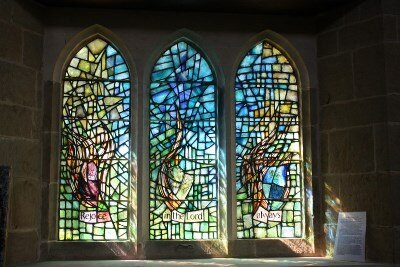 |
Depicting: The Power of the Holy Spirit Designer: Glenn Carter-(signed) Commemorates: Centenary of St Luke?s Date: 2000 |
An extract from Glenn Carter?s description of his design:
I have taken as a theme for my window the Power of the Holy spirit as described by St Luke in the Acts of the Apostles 2: 1-4. In choosing this symbolism of the Holy Spirit I was also mindful of the dedication given to Guildford Cathedral and the village of Grayshott which lies in an area of breckland where fire has been used as a renewing seasonal control. At the top of each flame and lit by the fire is a light or star. These are symbolic of the seven lamps and gifts of the Holy Spirit which are wisdom, understanding, counsel, ghostly strength, knowledge, true godliness and holy fear.
The landscape around the church is of important significance and this is featured in the design and detail of the window. Within the centre light at the top is a glowing area of blue. This area is representative of the Devil?s Punchbowl. Below these blues lie tinted greens forming a backdrop across the whole three windows being interspersed with yellows. The flames offer a strong yet lapping movement upwards through the lights and will be of orangey reds and yellows, interspersed with colours of the landscape; purples for heather, pinks for coniferous woodland.
Within each light there is a small cameo taken from the local landscape. The left hand window contains a spray of heather in a bed of purple and violets. The centre window shows a representation of oak leaves and acorns surrounded by deciduous greens; symbolic of one of the trees that were considered when building the cross and considered a wood of endurance and strength of faith and virtue. It is also the emblem of the National Trust who oversee a lot of the local landscape. In the right hand window and set in a brown tinted background is a gorse branch, again a plant found on the heath and a representative of the fragrance and beauty of the open heath-land.
Below the inclusions are the words, ? Rejoice in the Lord Always? and below the centenary dates 1900-2000.
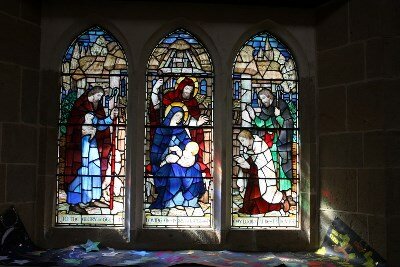 |
Depicting: Adoration of the Shepherds Designer: J. Hodges Cartoonist: A. F. Erridge Manufacturer: James Powell & Sons-(signed) Memorial to: Katherine May Lowry Date: 1936 |
North Aisle-East to West
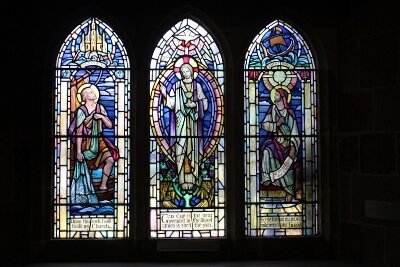 |
Depicting: St Peter, Christ and St Paul Designer: Jessie Bayes Manufacturer: Goddard & Gibbs Memorial to: Rev. James M. Jeakes and Albert Simms-Vicars of St Luke?s:1901-1907 & 1908-1926. Date: 1961 |
?
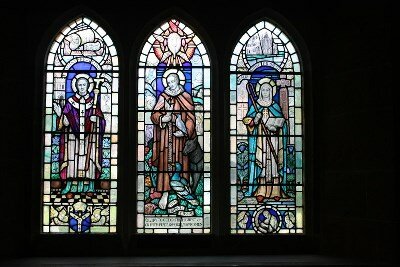 |
Depicting: St Augustine of Canterbury, St Francis of Assisi, St Hilda of Whitby Designer: Jessie Bayes Manufacturer: Goddard & Gibbs Memorial to: Marjory Pearman Date: 1955 |
?
 |
Depicting: St Matthew, St John the Divine, St Mark Designer: Jessie Bayes Manufacturer: Goddard & Gibbs Memorial to: Theodore Pearman Date: 1956 |
?
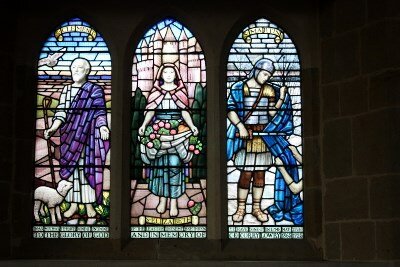 |
Depicting: St Clement, St Elizabeth, St Martin Designer: Joseph Wilson Forster Memorial to: C. E. Lowry Date: 1926 |
?
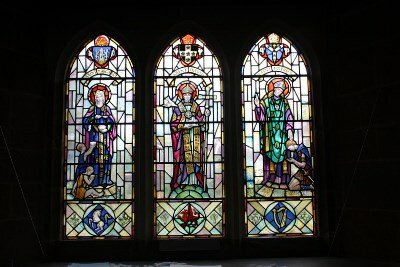 |
Depicting: St Patrick, St David, St Margaret Designer: Jessie Bayes Manufacturer: Goddard & Gibbs Memorial to: Robert C. Duggan Date: 1962 |
Brian Tapp
Grayshott Village Archive
Related GVA Articles:
The early years of St Luke?s Church
The Churchyard of St Luke?s & Other Memorials
History of St Luke's Church
 |
Notes and News???Total News: 34???Total Reads: 123073 |
|
Articles:
|
Most recent article: July / August / September 2014 Friend?s eveningsA most successful evening was held in May at the Social Club with almost 70 people attending. I spoke about some of the larger houses and estates in the district, much of this based on the sale documents recently given to the archive. Also the J.Arthur Coe billiards trophy (more details below) was officially handed back to the Village Hall management by Peter Hatch. Refreshments as usual kindly provided by Jan and John Bebbington. Next Friends evening will be on Tuesday 4th November at the Social Club. The subject this time will be 'Transport around Grayshott' from the horse drawn delivery vehicles, through the motor era, the Aldershot and District Bus Co. a major employer in the area and we may even find a picture or two of Sidney Jeffery?s ?Grayshott Coaches'! More details in due course. Archive committeeFollowing the AGM the following changes have taken place. Clive Slaughter who has represented the Parish Council has retired and his place taken by Ann Myers. We are also pleased to welcome John Hill to the team. The J. Arthur Coe billiards trophyFollowing the Friends evening last November about the Village Hall it was found that 'in store' at our hosts the Social Club was a trophy presented in 1911 to the Village Hall Men?s Club for an annual competition of billiards by J.Arthur Coe who lived at Moor House, Tilford Road, Hindhead. By good fortune the trophy has survived the closure of the club in the late 1970s. It has duly been handed back to the Village Hall where in due course it will be put on display. A minor point of interest is that the bus stop at the apex of the Tilford and Churt roads at Hindhead was always known as Coe's Corner. Future projects and new informationThe plaque to commemorate Grayshott?s involvement with the billeting of troops within the parish 1914/15 is at present being manufactured and will be displayed above one set of entrance doors to the Village Hall to commemorate the 100th anniversary of the commencement of the Great European War. A new item will shortly appear on our website in the form of a regular feature ?Do You Know?. Covering the district we hope it will be found of interest and bring forth more information. Other items of local interest have come to light recently. The donation to the Archive by Derek Hoy of a plated cigarette case inscribed ?Grayshott Military Hospital Xmas 1915'. The hospital was at the Catholic Church area of the Cenacle. Further information can be found on this website under previous articles. Tracey Sharpe, our secretary, is keen for the Archive to expand appeal to more local people, in particular those moving to the area in recent times. We are interested in gathering more information on the history of what have become housing estates around the village. Also we would like to talk with more of our long standing residents to record more of village life. BooksThe Grayshott War Memorial book is selling well and is available from the Pottery, Post Office, Village Kitchen Caterers and Applegarth. ? Richard Peskett |
 |
Photo of the Month???Total News: 51???Total Reads: 153467 |
|
Articles:
|
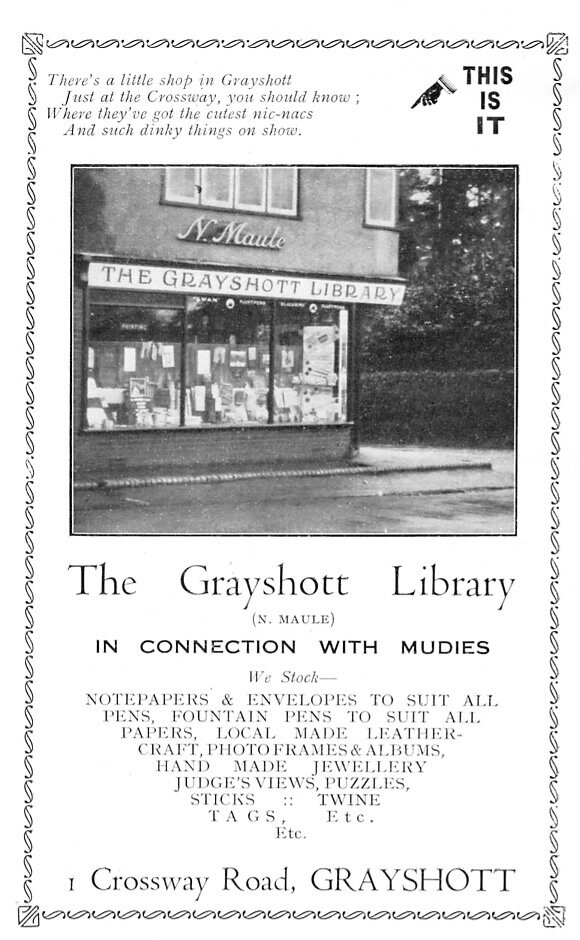
Most recent article: Grayshott Library
On the corner of Hill Road and Crossways Road the building started life as the Capital and Counties Bank in about 1904, being the first bank in Grayshott. After moving to Headley Raod in 1924 (now Lloyds bank) the premises became a stationers and library, this image dates from the late 1920s and it remained as such into the 1960s. Various changes subsequently, at present Liphook Valet Service. |